Interaction Design 2

INDIA2050

Scenarios of an uncertain future

India 2050 was a group project for Interaction Design 2, a course I took in the third year of college. Six of us worked together on it.

Aarushi Jhamb, Ananya Rajhans, Ananya Salian, Annie Vaithara, Heer Tanna, Kiara Rai

What does the future look like?

Research:

2050 predictions
by the Netherlands Environmental Assessment Agency in 2007 outlined a mixed outlook for India.

On the positive side, they anticipated increased life expectancy, educational advancements, renewable energy development, entrepreneurial growth, and empowerment of marginalized groups like Dalits and women.
However, they also foresaw challenges such as significant population growth, environmental degradation, water scarcity, urbanization issues, and economic decay due to corruption.

Further research suggests a global shift towards sustainable energy solutions by 2050, driven by concerns about fossil fuel depletion and greenhouse gas emissions. Transitioning away from fossil fuels is seen as crucial to avoiding catastrophic climate change effects. Europe, particularly the EU, is leading in this transition, but major emitters like the US, China, India, and Russia face challenges in balancing energy needs with environmental sustainability. Developing low-carbon energy sources, including solar, wind, hydro, and possibly nuclear, is essential for a sustainable future.

Initial Ideation

From Each Member

Aarushi Jhamb

Smart Libraries

Imagine having the best of both worlds when it comes to reading—enjoying the tactile experience of a physical book while harnessing the convenience of digital technology. Picture this: a revolutionary innovation where a paper-thin sheet transforms into a book filled with the text of your favorite PDFs, projected from your device.

See also Supporting Local Artists

In the world of jewelry making, challenges abound for manufacturers, retailers, and consumers alike. To support local artists and enhance sustainability in the industry...

  • AI-based tools can be developed to forecast economic trends, helping jewelry makers optimize their production costs.
  • An online platform powered by AI can allows customers to personalize their jewelry designs.
  • Technology can be explored to verify the authenticity of materials used, ensuring trust between artisans and consumers.
  • AI and blockchain can be employed to create transparent supply chains, promoting ethical sourcing practices.
Ananya Rajhans

Menstrual Health

The purpose is to improve the overall experience and well-being of individuals during their menstrual cycles. This involves addressing various aspects of menstruation, including tracking, managing symptoms, and providing support.

See also Online Shopping: Enhancing Convenience and Choice

To meet the needs of customers who are looking for ease, convenience, variety, and cost-effectiveness in their shopping experience and replicate, as closely as possible, the experience of physically examining and trying products before making a purchase.

Ananya Salian

AI for Dogs

Imagine a world where our furry friends could communicate their emotions and needs with us effortlessly. That's the vision driving the use of AI in understanding canine communication, strengthening bonds and ushering a new era of care.

See also Education: Online Learning
  • Global Learning Communities: Online learning fosters global communities where students and educators from different regions collaborate and share diverse perspectives, enriching the learning experience.
  • Professional Development: Online learning is crucial for professionals seeking continuous development, certification, and the acquisition of new skills to stay competitive in the job market.
Annie Vaithara

AI for Agriculture

A world where farmers are empowered by AI assistants, revolutionizing agriculture for greater productivity and sustainability. farming can become a dynamic partnership between human ingenuity and artificial intelligence.

See also Smart City Transportation

In the bustling urban landscape, the quest for smoother, safer transportation is a constant endeavor. With emergent technologies at the helm, cities are revolutionizing their traffic systems.

  • Augmented reality guides drivers with real-time updates on traffic conditions and alternative routes.
  • Vehicles communicate seamlessly with each other and infrastructure, paving the way for safer journeys.
  • Autonomous vehicles and ride-sharing services further alleviate congestion, as drones hover above, swiftly monitoring traffic and pinpointing issues. Advanced analytics crunch vast data sets to predict and optimize traffic flow, while dynamic pricing nudges commuters towards off-peak travel.
  • Environmental sensors keep tabs on air quality, and vehicle-to-grid integration hints at a greener future.
Heer Tanna

Languages: Bridging the gap

In a world where language barriers often hinder effective communication, innovative AI subtitle glasses emerge as a solution. These glasses seamlessly translate speech in real-time, displaying subtitles on the lenses in the listener's language as the conversation unfolds.

See also VR for Online Meetings

Immersive Interaction: VR can create a more immersive meeting environment, making participants feel as if they are in the same physical space. This sense of presence can enhance engagement and communication.

Kiara Rai

Virtual Museums

In response to declining interest and accessibility challenges facing traditional art galleries and museums, the integration of AR, VR, and emerging technologies seeks to revolutionize the art experience. By creating virtual gallery spaces and enhancing physical museum visits with immersive AR/VR installations and sound art, these innovations aim to engage audiences in new ways.

See also Smart Office

Picture a seamless blend of physical and virtual workspaces, where online employees feel connected and engaged just like their in-office counterparts. Recognizing the isolation of remote work, the smart office solution aims to foster interaction and collaboration through specialized devices or a dedicated app. Virtual reality facilitates immersive meetings, while online lounge spaces emulate the camaraderie of office breaks with games, chats, and shared entertainment. Enhanced video conferencing tools ensure smooth communication, and features like automatic work-hour cutoffs promote work-life balance. By bridging the gap between online and offline work experiences, we redefine the office environment for the modern era, prioritizing connectivity, productivity, and well-being

Narrowing down the topic

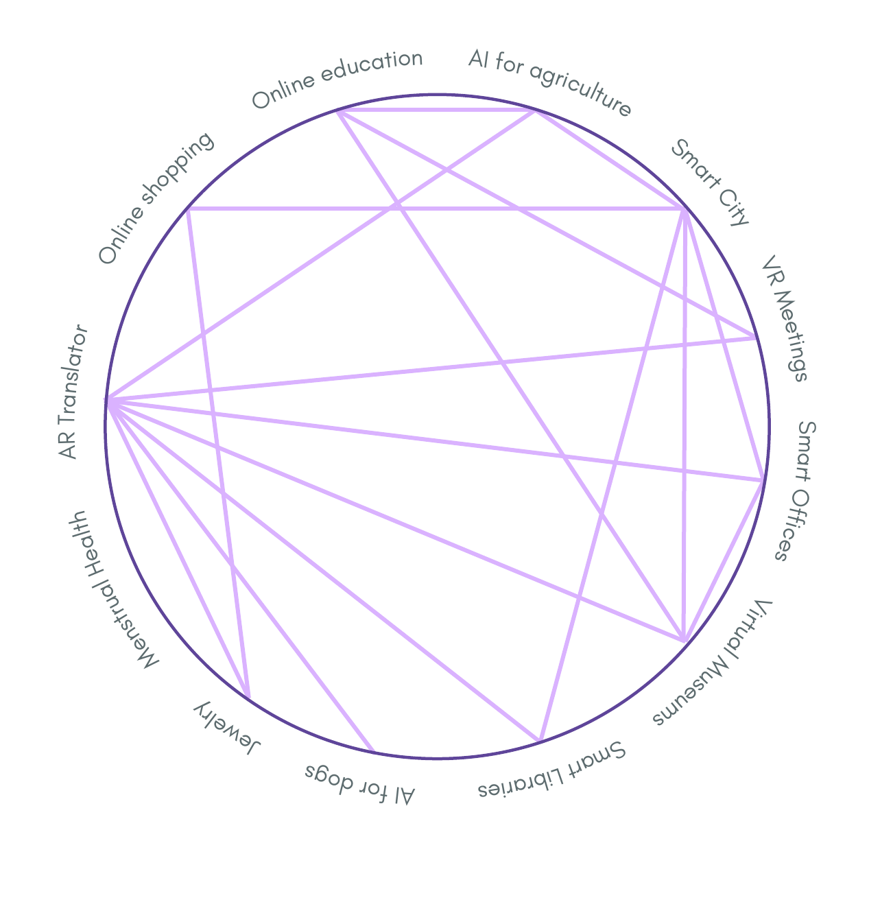
Circle of connections between the ideas: Online education, AI for agriculture, Smart City, VR Meetings, Smart Offices, Virtual Museums, Smart Libraries, AI for dogs, Jewelry, Menstrual Health, AR Translator, Online shopping

Upon further discussions and finding connections between our various ideas we narrowed it down to the concept of AR for languages.

AR For Languages

Including animalsLanguage learningTranslation

While discussing these ideas we also spoke about including:

  • Online learning
  • Mind reading - Note taking
  • VR Meetings
  • Smart Libraries

Out of these, we liked the idea of having a technological intervention for places where communication can be improved upon. So we chose the over-arching topic to be communication in the future and started discussing about what it would look like twenty years from now

World Building

WHY?

As a six-member group, achieving alignment on our vision for the 2050 world was essential. To ensure coherence, we conducted a world-building exercise. This foundational step allowed us to establish a shared understanding of key elements shaping our imagined future. With this groundwork laid, we were equipped to ideate and speculate effectively for our envisioned world.

WHAT?
Geography
In India's megacities, a network of eco-friendly elevated transit systems, managed by advanced AI, connects urban hubs.
Utilizing tunnel-boring technology, underground spaces alleviate overcrowding while maximizing land usage.
Climate
Solar farms and wind turbines, supported by AI, dot arid regions for efficient energy production.
Climate-resilient urban planning integrates green infrastructure to combat rising temperatures.
Resources
Vertical farming skyscrapers with AI-controlled hydroponic systems optimize food production.
Advanced recycling facilities, powered by nanotechnology, minimize waste.
Transport
Autonomous electric vehicles with swarm intelligence ease traffic, alongside high- speed Hyperloop and maglev trains.
Drone-based courier systems enhance urban delivery while reducing road congestion.
Architecture
Biomimetic architecture blends traditional Indian design with 3D-printed eco-materials.
Smart buildings adapt to weather and preferences, featuring self-healing facades.
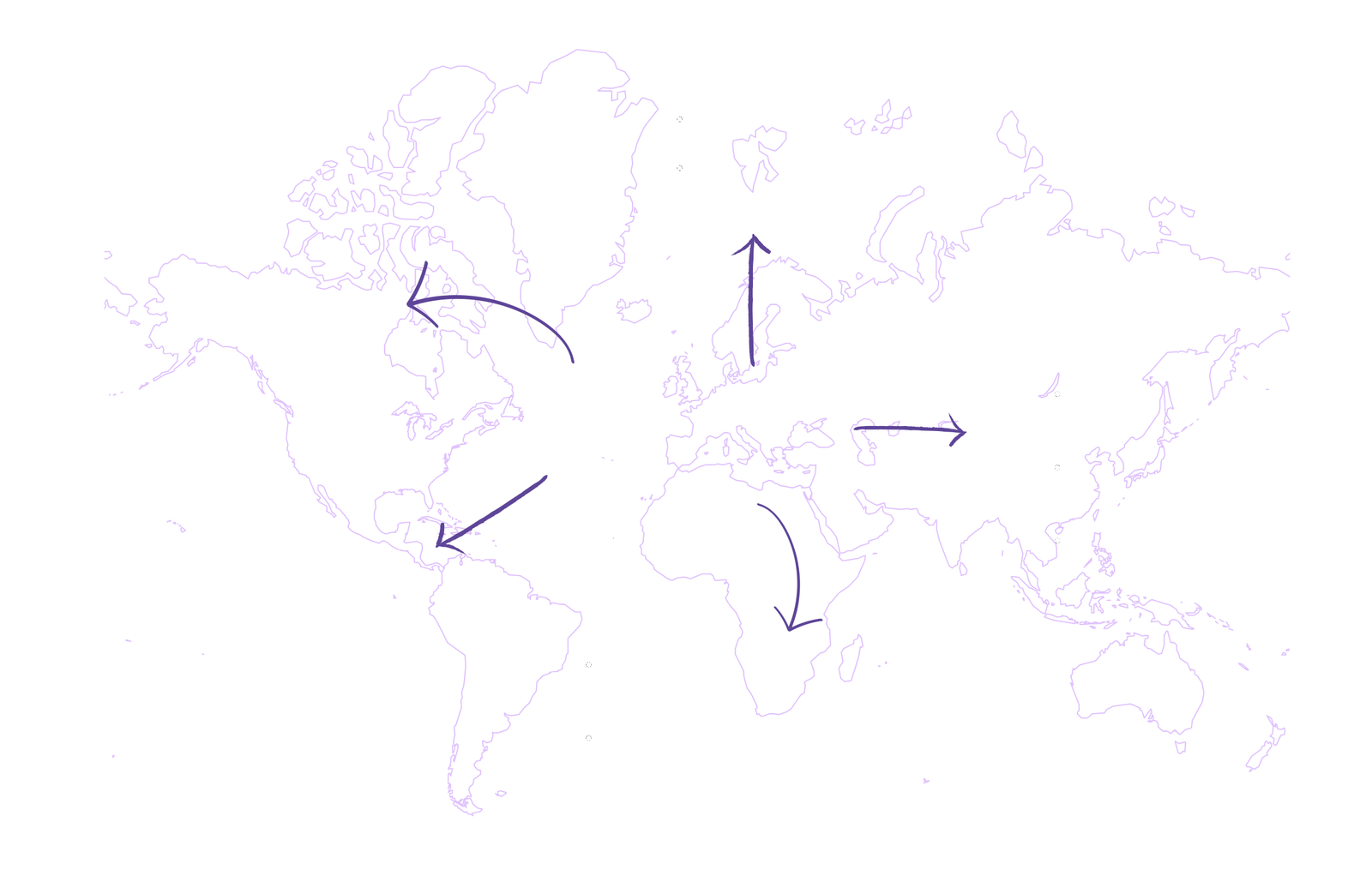
A world map drawn in glowing purple outline on black, with arrows tracing movements between the continents: the base map for the team's world building.
World BuildingImagining India 2050
Geography
  • India's megacities interconnected by a web of eco-friendly, elevated transit systems powered by advanced AI-driven traffic management.
  • Underground urban spaces created using tunnel-boring technology to alleviate overcrowding and maximize land use.
Climate
  • Massive solar farms and wind turbine arrays across arid regions, augmented by AI for efficient energy generation and storage.
  • Climate-adaptive urban planning incorporating advanced materials and green infrastructure to combat rising temperatures.
Resources
  • Vertical farming skyscrapers with automated hydroponic systems and AI-controlled climate and nutrient management, minimizing land use and maximizing food production.
  • Advanced recycling facilities using nanotechnology to break down waste into reusable materials with minimal energy consumption.
Transport
  • Autonomous electric vehicles (AEVs) equipped with swarm intelligence, reducing traffic congestion and accidents.
  • Hyperloop and maglev trains for high-speed, efficient intercity travel, enhanced by AI for traffic control and maintenance.
  • Drone-based courier systems for urban delivery and transportation, reducing road traffic.
Architecture
  • Biomorphic architecture integrating traditional Indian design elements with 3D-printed, eco-friendly materials.
  • Smart buildings with self-healing facades, changing colors and textures based on weather conditions or personal preferences.

Ideating for India 2050

Communicating
with 2050

Moving ahead we deliberately refrained from conforming to the simplistic concepts of utopia and dystopia, recognizing the complexity of the future and its multifaceted nature. It is a consensus among us that the future, no matter how it unfolds, will not be uniformly utopic or dystopic.

In light of this, we collectively opted to pursue a diversified approach by crafting three distinct prototypes that remained interconnected within the same conceptual universe. Each prototype sought to explore unique scenarios and innovative means of realizing these scenarios.

The specific world focused on is the aspect of emotional translation and communication through our emotions.

See how Heer, a design college student, communicates in 2050...

↓  Prototype

Figma prototype

Open in Figma ↗

Interactive prototype

Runs here in the page. If it doesn't load, open it in Figma ↗

INDIA2050 · Scenarios of an uncertain futureWeb design by Annie Vaithara